Dominican Slang: 25 Words and Phrases to Understand Dominicans
Dominican Spanish is famous among learners for one reason: it is fast. Consonants disappear, words merge, and on top of that comes a vocabulary you will not find anywhere else. Even other Spanish speakers sometimes need a second to catch up.
The good news is that a small set of words carries a lot of Dominican conversation. Learn these, get used to the sound, and Dominican music, YouTube and conversation open up.
🗣️ The ten you will hear first
| Slang | Meaning | Example |
|---|---|---|
| ¿Qué lo que? / klk | What's up? | ¡Klk, mi hermano! |
| vaina | thing, stuff, situation | Pásame esa vaina. |
| un chin | a little bit | Dame un chin. |
| tíguere | street-smart guy, hustler | Ese es un tíguere. |
| jevi | cool (from English "heavy") | Esa fiesta está jevi. |
| pana | friend | Él es mi pana. |
| tato | OK, deal | Nos vemos mañana. — Tato. |
| dímelo | hey, what's up (greeting) | ¡Dímelo! |
| guagua | bus | Cogí la guagua. |
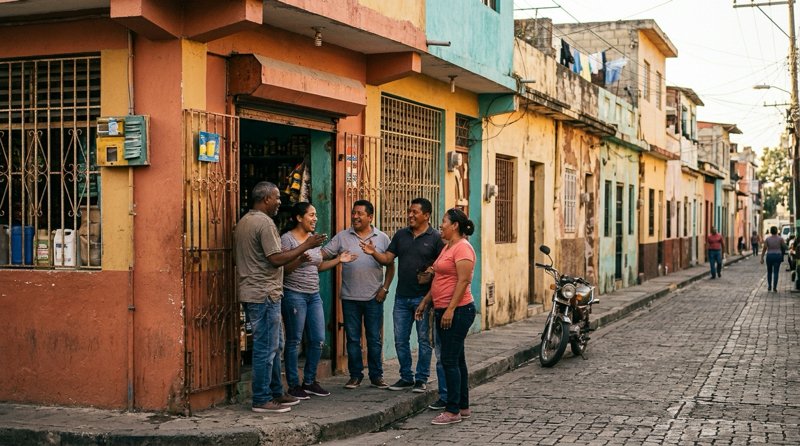
| colmado | corner shop | Voy al colmado. |
Vaina is the word you will hear most. It can mean almost anything: a thing, a problem, a situation. ¡Qué vaina! is "what a mess!"; esa vaina is "that thing". When a Dominican cannot remember a word, it becomes vaina.
Klk is how ¿qué lo que? is written in messages, and it is everywhere online.
👥 People
| Slang | Meaning |
|---|---|
| pana, mi hermano | friend, bro |
| tíguere | streetwise, smooth operator (can be praise or warning) |
| jeva | girlfriend, young woman |
| jevito / jevita | posh young person |
| pariguayo | awkward, uncool person; a wallflower at a party |
| carajito | kid (informal) |
Pariguayo has a famous origin story: it supposedly comes from "party watcher", the outsiders who watched dances without joining in. True or not, it is the word for someone who does not dance.
🍽️ Daily life
- Concho — a shared taxi on a fixed route.
- Motoconcho — a motorbike taxi.
- Colmado — the neighbourhood corner shop, and often its social centre.
- La bandera — rice, beans and meat, the everyday Dominican lunch ("the flag").
- Jartura — that stuffed feeling after eating too much.
- Chercha — a chat, banter, hanging out talking.
- Boche — a telling-off. Me dieron un boche.
- Estar guapo — to be angry. Not "handsome": está guapo means he is annoyed.
- Diache — a mild "damn!" of surprise.
Estar guapo is the classic trap. In most of the Spanish-speaking world it would mean "to look good". In the Dominican Republic, it means someone is angry with you.
👂 Why Dominican Spanish sounds so fast
It is not only speed. Several sound changes stack up:
- Final s disappears. Los amigos sounds like lo amigo. Estás becomes etá.
- Final r and l change. In some regions comer sounds like comel; in the Cibao region, in the north, r and l often become an i sound: poique for porque.
- Syllables merge. Para becomes pa, nada becomes na, está becomes ta: ¿Tú ta bien?
- The rhythm is quick and musical, like a lot of Caribbean Spanish.
None of this is "wrong" Spanish. It is a regional accent, like a Glaswegian or Texan accent in English, and it is learnable with exposure.
🎧 Learning Dominican Spanish by ear
Dominican music is the best door in. Bachata and merengue are full of everyday vocabulary, and Juan Luis Guerra in particular sings clearly enough to follow with lyrics. For dembow and newer urban music, wait until your listening is stronger.
- Start with clearer Spanish first, then add Dominican listening. See Mexican or Castilian Spanish for which variety to start with.
- Listen to Dominican speakers on YouTube with Spanish subtitles, so you see the words your ear is not catching yet: Spanish subtitles to learn Spanish.
- Learn songs line by line: Learning Spanish with music.
- Test yourself on real audio. Gappier hides words from a YouTube video's real subtitles and pauses until you type what you heard. With an accent this fast, it shows you exactly which sounds are being swallowed.
❓ Frequently asked questions
What language do they speak in the Dominican Republic?
Spanish. It is the official language and almost everyone's first language. Dominican Spanish is a Caribbean variety, close to Puerto Rican and Cuban Spanish.
Is Dominican Spanish real Spanish?
Yes. It has its own accent and vocabulary, but its grammar is standard Spanish, and Dominicans switch to more neutral speech when they need to.
What does klk mean?
It is short for ¿qué lo que?, "what's up?". It is used as a greeting in person and in messages.
What does un chin mean?
A little bit. Un chin de azúcar is a bit of sugar; espérame un chin is "wait a moment".
Is Dominican Spanish hard to understand?
For learners, yes, at first: it is one of the fastest varieties. Start with a clearer accent and add Dominican listening once you are past beginner level.
✅ In short
- Dominican Spanish is fast, with dropped s, changed r and l and merged syllables.
- Start with klk, vaina, un chin, tíguere, jevi, pana, tato.
- Watch out for estar guapo: it means angry.
- Learn it from Dominican music and speakers, after a clearer variety.